Angela Merkel Us Uk Enemies of Germany Once Again
Chancellor Angela Merkel volition exit active politics after the German federal elections on 26 September 2021. As Merkel's difference after xvi years will resonate across Europe, the Clingendael Spectator invited several international experts to offer their personal reflections on her legacy. In this seventh episode of the series 'Europe after Merkel', Anand Menon takes a UK perspective: the primal lesson of the Merkel years is a chronic and repeated inability to understand the German chancellor.
Germany and the U.k. are, nosotros are told, "strong and like-minded global partners" who "share a strategic vision on broader foreign and security policy problems". Such at least was the merits made in the articulation annunciation of June 2021, signed every bit Chancellor Angela Merkel basked in a valedictory visit to London. one
These warm words hide a different reality. A shared Anglo-German language strategic vision there might be. Simply, below the level of grand political abstraction, possibly the key lesson of the Merkel years is a chronic and repeated inability to sympathize the German chancellor. Take, in society, the five British prime ministers that Merkel has survived during her sixteen years equally chancellor.
Information technology was Merkel who worked with French president Nicholas Sarkozy to undermine Tony Blair's prospects of becoming European Council president in 2009. 2 Personal relations betwixt the pair were good, just at that point, centre-correct governments outweighed those of the centre-left by three to one.
Merkel felt this should exist reflected in the European union's institutions. In turn, this underestimation of Merkel's ideological fidelity to the heart-right led the government of Gordon Brown to underestimate her opposition to a Keynesian fiscal response to the global fiscal crisis of 2007. three
David Cameron'south first decision – made earlier becoming Conservative leader – to detach from the mainstream centre-right is both an underappreciated aspect of the Brexit story and reflective of the differences between the two leaders. Merkel made it articulate during the Tory leadership campaign in 2005 what she thought of his campaign pledge to withdraw from the European People'southward Party (EPP): "I look forward to skilful and intensive cooperation with you, in particular inside the framework of the EPP-ED every bit a clear base for our bilateral dialogue every bit partners." 4
Cameron chose to read between the lines, rather than taking Merkel at face up value. United kingdom politicians have spent many years assuming Deutschland was committed not just to shut cooperation, but besides to preserving bilateral trade. Information technology was because of this that Cameron believed Chancellor Merkel would help him deliver what he needed in his 'renegotiation' of the terms of Great britain membership of the Eu.
During that renegotiation, Merkel made it clear that Cameron'south demands – peculiarly on gratuitous motion – bemused her. In response to the argument that the Great britain should be able to care for EU citizens every bit migrants, and cap the number of those arriving, she remarked, caustically: "You have low unemployment, a booming economy, y'all're growing faster than most of Europe, at that place'due south no social crisis. And you are pulling in highly qualified labour, cheaply. Explain to me what the trouble is." 5
The chancellor would prioritise the effective working of the Eu over bilateral links
And, in one case the renegotiation and the plebiscite had played out, the reassurances that Merkel would come up to the rescue began in one case again. David Davis, the Main Negotiator and Secretarial assistant of State of Exiting the European Union, famously declared that: "Nosotros are likewise valuable a market for Europe to shut off. Within minutes of a vote for Brexit the CEO's [sic] of Mercedes, BMW, VW and Audi will exist knocking downwards Chancellor Merkel'south door demanding that in that location be no barriers to German admission to the British market place. And while they are at information technology they will be demanding that those British companies that they own will have uninterrupted access to Europe." half dozen
Had British politicians (and, indeed, the unnamed French official) spent more than time studying Merkel's Deutschland, and less simply bold it would ride to the rescue of the UK, the reality was there for all to see. The chancellor would prioritise the constructive working of the European Union over bilateral links.
And nonetheless, delusions persisted. Throughout the tortuous Brexit negotiations, leading British politicians and commentators continued to vocalization their conventionalities that Merkel would help united states of america out, despite her unequivocal insistence on the indivisibility of the 4 freedoms. seven
In the week leading up to the launch of Theresa May's Chequers plan, a paper concerning Brexit and the future relationship betwixt the UK and Eu, she flew to Berlin with her Master of Staff Gavin Barwell and Chief Negotiator Olly Robbins. The meeting with Merkel led Barwell to feel "probably the best I ever felt about our prospects of getting Brexit over the line". 8 Nonetheless, Chiffonier agreement on the Chequers program was followed by an awkward diplomatic silence from Berlin.
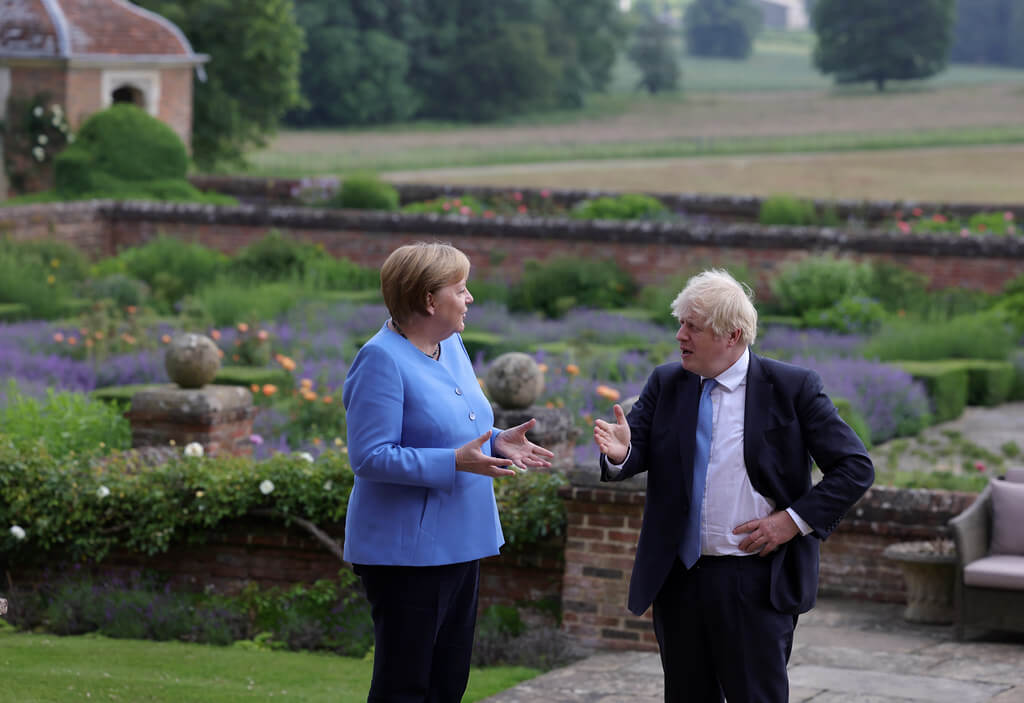
Again, a diplomatic misunderstanding of Frg led the Uk downwards the garden path. Indeed, throughout, while the stance of Boris Johnson's regime in detail dislocated many in Berlin, Merkel remained house in her belief that the EU should not sign a deal with London "at any price". 9
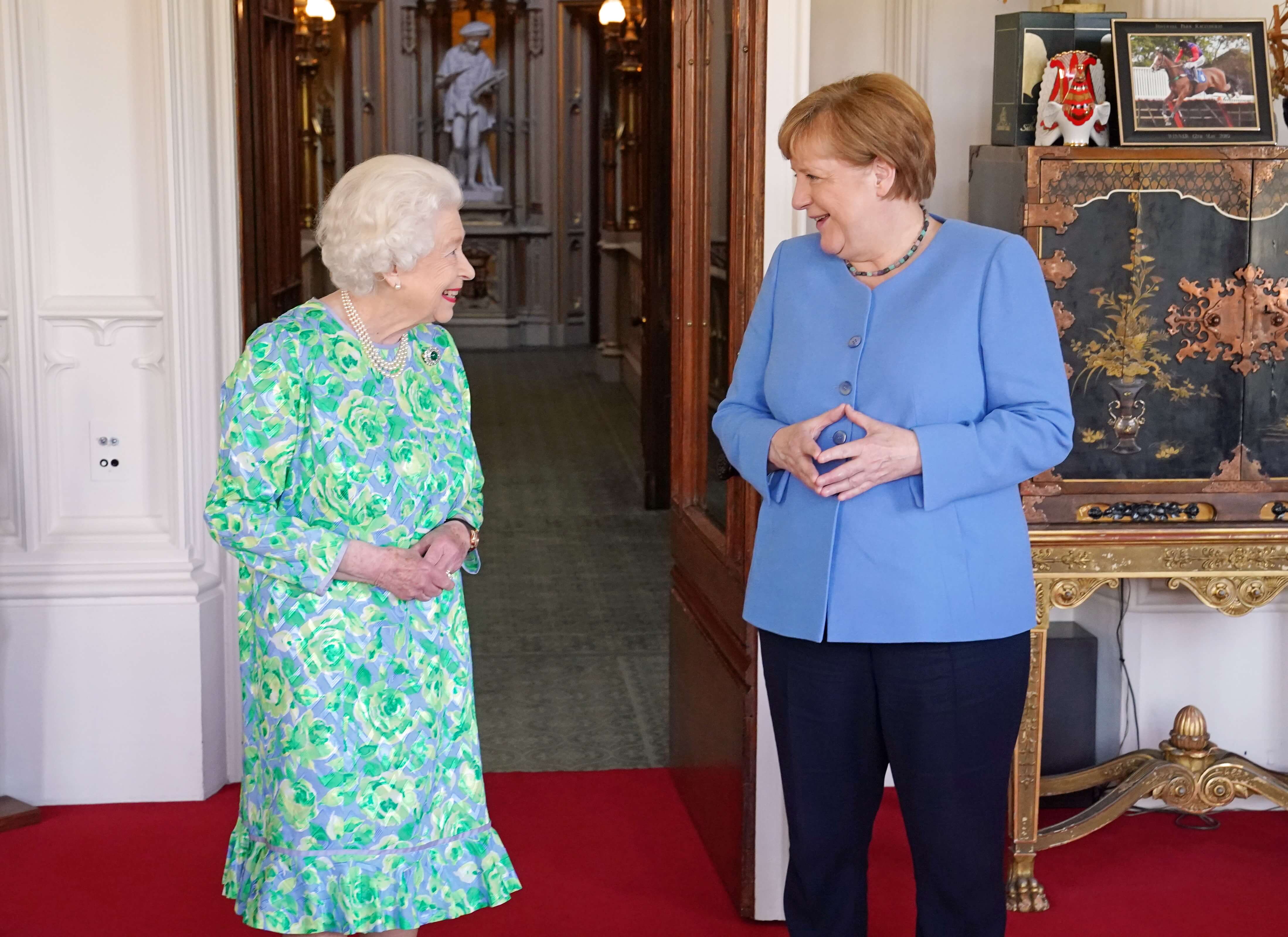
So, we arrive at June 2021. Merkel's visit included all the bells and whistles of a major state event: a visit to the Queen, a new bilateral foreign policy agreement, an academic medal in her honour. 10 The tone of the articulation announcement certainly came as something of a surprise to many in the EU, coming, every bit it did, at a time when London and Brussels were at loggerheads over the implementation of the Northern Republic of ireland protocol.
A choice between this relationship and EU solidarity would nonetheless exist a no-brainer for whatsoever German chancellor
Yet, once again, we should not kid ourselves. There is conspicuously a want in Berlin to work closely with the UK, specially on bug such equally security where EU capabilities remain limited. Withal, a selection between this relationship and Eu solidarity would still exist a no-brainer for whatsoever German chancellor. And, if Merkel'south Christian Democratic Matrimony of Deutschland (CDU) is out of power and the next chancellor is from a different political tradition to the prime minister, Boris Johnson should not fault politeness for shared priorities.
Or, instead of reading between the lines, we could perhaps heed Merkel'southward clear advice on her final trip to London: "We look at each other, we look at how different people can be, and we make the all-time of it." 11
Source: https://spectator.clingendael.org/nl/publicatie/merkel-and-uk-shared-vision-lack-understanding
0 Response to "Angela Merkel Us Uk Enemies of Germany Once Again"
Post a Comment