People Tree Films Baby's First Sounds Discoveries for Little Ears

Classical music generally refers to the formal musical tradition of the Western world, considered to be singled-out from Western folk music or popular music traditions. It is sometimes distinguished as Western classical music, every bit the term "classical music" may too refer to non-Western traditions which showroom like formal qualities. In addition to formality, classical music is often characterized by complication in its musical form and harmonic organisation,[one] particularly with the employ of polyphony.[two] Since at least the 9th-century it has been primarily a written tradition,[ii] spawning a sophisticated notational arrangement, likewise as accompanying literature in analytical, critical, historiographical, musicological and philosophical practices. A foundational component of Western Civilisation, classical music is frequently seen from the perspective of private or groups of composers, whose compositions, personalities and behavior have fundamentally shaped its history.
Rooted in the patronage of churches and royal courts in Western Europe,[1] early medieval music was chiefly religious, monophonic and song, with the music of ancient Greece and Rome influencing its thought and theory. The earliest extant music manuscripts date from the Carolingian Empire (800–888),[iii] around the time which Western plainchant gradually unified into what is termed Gregorian chant.[4] Musical centers existed at the Abbey of Saint Gall, the Abbey of Saint Martial and Saint Emmeram's Abbey, while the 11th-century saw the development of staff notation and increasing output from medieval music theorists. By the mid-12th century France became the major European musical center:[3] the religious Notre-Matriarch school first fully explored organized rhythms and polyphony, while secular music flourished with the troubadour and trouvère traditions led past poet-musician nobles.[five] This culminated in the court sponsored French ars nova and Italian Trecento, which evolved into ars subtilior, a stylistic move of extreme rhythmic multifariousness.[v] Beginning in the early 15th-century, Renaissance composers of the influential Franco-Flemish School congenital off the harmonic principles in the English contenance angloise, bringing sacred music to new standards, particularly the mass and motet.[half-dozen] Northern Italian republic shortly emerged equally the central musical region, where the Roman Schoolhouse engaged in highly sophisticated methods of polyphony in genres such as the madrigal,[6] which inspired the brief English Madrigal School.
The Baroque period (1580–1750) saw the relative standardization of common-do tonality,[7] also every bit the increasing importance of musical instruments, which grew into ensembles of considerable size. Italy remained ascendant, existence the birthplace of opera, the soloist centered concerto genre, the organized sonata form besides as the large calibration vocal-centered genres of oratorio and cantata. The fugue technique championed by Johann Sebastian Bach exemplified the Bizarre tendency for complexity, and equally a reaction the simpler and song-like galant music and empfindsamkeit styles were adult. In the shorter but pivotal classical period (1730–1820) composers such as Wolfgang Amadeus Mozart, Joseph Haydn, and Ludwig van Beethoven created widely admired representatives of absolute music,[8] [9] including symphonies, string quartets and concertos. The subsequent Romantic music (1800–1910) focused instead on programmatic music, for which the fine art song, symphonic verse form and various pianoforte genres were of import vessels. During this time virtuosity was celebrated, immensity was encouraged, while philosophy and nationalism were embedded—all aspects that converged in the operas of Richard Wagner. Past the 20th-century, stylistic unification gradually prodigal while the prominence of popular music increased exponentially. Many composers actively avoided past techniques and genres in the lens of modernism, with some abandoning tonality in place of serialism, while others found new inspiration in folk melodies or impressionist sentiments. Subsequently World War Ii, for the first time audition members valued older music over gimmicky works, a preference which has been catered to by the emergence and widespread availability of commercial recordings.[ten] Trends of the mid 20th-century to the present day include New Simplicity, New Complexity, Minimalism, Spectral music, and more recently Postmodern music and Postminimalism. Increasingly global, practitioners from the Americas, Africa and Asia have obtained crucial roles,[3] while symphony orchestras and opera houses now announced beyond the world.
Terminology and definition [edit]
Ideological origins [edit]
Both the English language term "classical" and the German equivalent klassik developed from the French classique, itself derived from the Latin give-and-take classicus, which originally referred to the highest form of Ancient Roman citizens.[11] [n 1] In Roman usage, the term later became a means to distinguish revered literary figures;[eleven] the Roman author Aulus Gellius commended writers such as Demosthenes and Virgil as classicus.[13] By the Renaissance, the adjective had acquired a more than full general meaning: an entry in Randle Cotgrave'south 1611 A Dictionarie of the French and English language Tongues is among the primeval extant definitions, translating classique every bit "classical, formall [sic], orderlie, in due or fit ranke; also, approved, authenticall, chiefe, principall".[11] [fourteen] The musicologist Daniel Heartz summarizes this into ii definitions: one) a "formal discipline" and ii) a "model of excellence".[11] Like Gellius, subsequently Renaissance scholars who wrote in Latin used classicus in reference to writers of classical antiquity;[12] [n 2] notwithstanding, this pregnant but gradually adult, and was for a while subordinate to the broader classical ideals of formality and excellence.[xv] Literature and arts—for which substantial Ancient Greek and Roman examples existed—did eventually adopt the term "classical" as relating to classical antiquity, just virtually no music of that time was available to Renaissance musicians, limiting the connectedness betwixt classical music and the Greco-Roman world.[15] This is why the Neoclassicism movement of the mid 18th-century was widespread in fields such as architecture and painting merely not music.[16]
It was in 18th-century England that the term "'classical' showtime came to stand up for a detail canon of works in operation."[15] London had developed a prominent public concert music scene, unprecedented and unmatched past other European cities.[xi] The royal courtroom had gradually lost its monopoly on music, in large office from instability that the Commonwealth of England's dissolution and the Glorious Revolution enacted on court musicians.[11] [northward 3] In 1672 the former court musician John Banister began giving popular public concerts at a London tavern;[n 4] his popularity apace inaugurated the prominence of public concerts in the London.[nineteen] The conception of "classical"—or more often "aboriginal music"—emerged, which was still built on the principles of formality and excellence, and according to Heartz "borough ritual, religion and moral activism figured significantly in this novel structure of musical sense of taste".[15] The performance of such music was specialized by the Academy of Ancient Music and subsequently at the Concerts of Antient Music series, where the work of select 16th and 17th composers was featured,[xx] especially George Frideric Handel.[15] [north 5] In France, the reign of Louis XIV ( r. 1638–1715) saw a cultural renaissance, by the end of which writers such equally Molière, Jean de La Fontaine and Jean Racine were considered to have surpassed the achievements of classical antiquity.[21] They were thus characterized as "classical", as was the music of Jean-Baptiste Lully (and later Christoph Willibald Gluck), being designated as "50'opéra française classique".[21] In the rest of continental Europe, the abandonment of defining "classical" every bit coordinating to the Greco-Roman World was slower, primarily considering the formation of canonical repertoires was either minimal or exclusive to the upper classes.[15]
Many European commentators of the early 19th-century found new unification in their definition of classical music: to juxtapose the older composers Wolfgang Amadeus Mozart, Joseph Haydn, and (excluding some of his later works) Ludwig van Beethoven as "classical" against the emerging style of Romantic music.[22] [23] [24] These three composers in particular were grouped into the First Viennese School, sometimes called the "Viennese classics",[n half-dozen] a coupling that remains problematic by reason of none of the iii beingness built-in in Vienna and the minimal time Haydn and Mozart spent in the metropolis.[25] While this was an often expressed characterization, it was not a strict 1. In 1879 the composer Charles Kensington Salaman defined the following composers as classical: Bach, Handel, Haydn, Mozart, Beethoven, Weber, Spohr and Mendelssohn.[26] More than broadly, some writers used the term "classical" to mostly praise well-regarded outputs from various composers, particularly those who produced many works in an established genre.[11] [north 7]
Contemporary understanding [edit]
The gimmicky understanding of the term "classical music" remains vague and multifaceted.[31] [32] Other terms such as "art music", "canonic music", "cultivated music" and "serious music" are largely synonymous.[33] The term "classical music" is often indicated or unsaid to business organization solely the Western world,[34] and conversely, in many academic histories the term "Western music" excludes non-classical Western music.[35] [n eight] Some other complication lies in that "classical music" is sometimes used to depict non-Western fine art music exhibiting similar long-lasting and complex characteristics; examples include Indian classical music (Carnatic and Hindustani music), Gamelan music, and various styles of the courtroom of Imperial China (see yayue for instance).[1] Thus in the afterward 20th-century terms such as "Western classical music" and "Western art music" came in use to accost this.[34] The musicologist Ralph P. Locke notes that neither term is ideal, as they create an "intriguing complication" when considering "sure practitioners of Western-art music genres who come from non-Western cultures".[37] [n nine]
Complexity in musical course and harmonic organization are typical traits of classical music.[i] The Oxford English Dictionary (OED) offers three definitions for the give-and-take "classical" in relation to music:[27]
- "of acknowledged excellence"
- "of, relating to, or feature of a formal musical tradition, as distinguished from pop or folk music"
- and more than specifically, "of or relating to formal European music of the tardily 18th and early 19th centuries, characterized by harmony, balance, and adherence to established compositional forms".
The last definition concerns what is now termed the Classical menstruation, a specific stylistic era of European music from the second half of the 18th-century to the beginning of the 19th century.[38]
History [edit]
The major time divisions of classical music up to 1900 are the Early on music catamenia, which includes Medieval (500–1400) and Renaissance (1400–1600) eras, and the Mutual practice menstruum, which includes the Bizarre (1600–1750), Classical (1750–1820), and Romantic (1810–1910) eras. The current period encompasses the 20th and the 21st century to date and includes the Modernist musical era and the Contemporary or Postmodern musical era, the dates of which are frequently disputed. The dates are generalizations, since the periods and eras overlap and the categories are somewhat arbitrary, to the point that some authorities reverse terminologies and refer to a mutual-practice "era" comprising baroque, classical, and romantic "periods".[39]
Roots [edit]
The Western classical tradition formally begins with music created past and for the early Christian Church.[40] Information technology is likely that the early Church wished to disassociate itself from the predominant music of ancient Hellenic republic and Rome, as it was a reminder of the pagan faith it had persecuted and been persecuted past.[40] As such, it remains unclear equally to what extent the music of the Christian Church, and thus Western classical music every bit a whole, was influenced past preceding aboriginal music.[41] The general mental attitude towards music was adopted from the Ancient Greek and Roman music theorists and commentators;[42] [n x] similar in Greco-Roman gild, music was seen as a primal to education, and included in the quadrivium which, in combination with the trivium, fabricated upward the standard liberal arts education of the Middle Ages.[44] This loftier regard for music was first promoted by the scholars Cassiodorus, Isidore of Seville,[45] and particularly Boethius,[46] whose transmission and expansion on the perspectives of music from Pythagoras, Aristotle and Plato were crucial in the development of medieval musical idea.[47] Even so, scholars, medieval music theorists and composers regularly misinterpreted or misunderstood the writings of their Greek and Roman predecessors.[48] This was due to the complete absence of surviving Greco-Roman musical works bachelor to medieval musicians,[48] [due north 11] to the extent that Isidore of Seville (c. 559 – 636) stated "unless sounds are remembered past human being, they perish, for they cannot be written down", unaware of the systematic notational practices of Ancient Greece centuries before.[49] Musicologist Gustave Reese notes, however, that many Greco-Roman texts can still be credited as influential to Western classical music, since medieval musicians regularly read their works—regardless of whether they were doing so correctly.[48]
However, in that location are some indisputable musical continuations from the ancient world.[l] Basic aspects such every bit monophony, improvisation and the dominance of text in musical settings are prominent in both early on medieval in music of well-nigh all ancient civilizations.[51] Greek influences in item include the church modes (which were descendants of developments by Aristoxenus and Pythagoras),[52] basic acoustical theory from pythagorean tuning,[41] as well as the primal office of tetrachords.[53] Ancient Greek instruments such equally the aulos (a reed musical instrument) and the lyre (a stringed instrument similar to a modest harp) eventually led to several modern-day instruments of a symphonic orchestra.[54] However, Donald Jay Grout notes that attempting to create a direct evolutionary connection from the ancient music to early medieval is baseless, as it was nearly solely influenced by Greco-Roman music theory, not operation or practise.[55]
Early music [edit]
Medieval [edit]
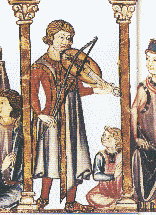
Medieval music includes Western European music from after the fall of the Western Roman Empire by 476 to about 1400. Monophonic chant, also called plainsong or Gregorian chant, was the dominant form until about 1100.[56] Christian monks adult the first forms of European musical notation in society to standardize liturgy throughout the Church.[57] [58] Polyphonic (multi-voiced) music developed from monophonic chant throughout the late Middle Ages and into the Renaissance, including the more than complex voicings of motets. During the earlier medieval period, the vocal music from the liturgical genre, predominantly Gregorian chant, was monophonic, using a single, unaccompanied vocal melody line.[59] Polyphonic vocal genres, which used multiple independent vocal melodies, began to develop during the loftier medieval era, becoming prevalent past the later 13th and early 14th century. Notable Medieval composers include Hildegard of Bingen, Léonin, Pérotin, Philippe de Vitry, Guillaume de Machaut, Francesco Landini, and Johannes Ciconia.
Many medieval musical instruments however be, but in unlike forms. Medieval instruments included the flute, the recorder and plucked string instruments like the lute. As well, early versions of the organ and fiddle (or vielle) existed. Medieval instruments in Europe had virtually normally been used singly, often self accompanied with a drone note, or occasionally in parts. From at least as early as the 13th century through the 15th century there was a division of instruments into haut (loud, shrill, outdoor instruments) and bas (quieter, more intimate instruments).[lx] A number of instrument take roots in Eastern predecessors that were adopted from the medieval Islamic world.[61] For instance, the Arabic rebab is the antecedent of all European bowed string instruments, including the lira, rebec and violin.[62] [63]
Renaissance [edit]
The Renaissance era was from 1400 to 1600. It was characterized by greater use of instrumentation, multiple interweaving melodic lines, and the utilize of the first bass instruments. Social dancing became more widespread, so musical forms appropriate to accompanying dance began to standardize. Information technology is in this fourth dimension that the notation of music on a staff and other elements of musical notation began to have shape.[64] This invention made possible the separation of the composition of a piece of music from its transmission; without written music, transmission was oral, and bailiwick to change every fourth dimension it was transmitted. With a musical score, a work of music could exist performed without the composer's presence.[65] The invention of the movable-type press press in the 15th century had far-reaching consequences on the preservation and transmission of music.[66]

Many instruments originated during the Renaissance; others were variations of, or improvements upon, instruments that had existed previously. Some have survived to the present day; others have disappeared, just to be re-created in club to perform music on period instruments. As in the modernistic day, instruments may be classified equally brass, strings, percussion, and woodwind. Brass instruments in the Renaissance were traditionally played by professionals who were members of Guilds and they included the slide trumpet, the wooden cornet, the valveless trumpet and the sackbut. Stringed instruments included the viol, the rebec, the harp-like lyre, the hurdy-gurdy, the lute, the guitar, the cittern, the bandora, and the orpharion. Keyboard instruments with strings included the harpsichord and the clavichord. Percussion instruments include the triangle, the Jew's harp, the tambourine, the bells, the rumble-pot, and various kinds of drums. Woodwind instruments included the double-reed shawm (an early on member of the oboe family unit), the reed piping, the bagpipe, the transverse flute, the recorder, the dulcian, and the crumhorn. Unproblematic pipe organs existed, simply were largely confined to churches, although there were portable varieties.[67] Printing enabled the standardization of descriptions and specifications of instruments, as well every bit instruction in their use.[68]
Vocal music in the Renaissance is noted for the flourishing of an increasingly elaborate polyphonic style. The principal liturgical forms which endured throughout the entire Renaissance menstruum were masses and motets, with some other developments towards the end, especially as composers of sacred music began to adopt secular forms (such every bit the madrigal) for their own designs. Towards the end of the period, the early dramatic precursors of opera such as monody, the madrigal one-act, and the intermedio are seen. Around 1597, Italian composer Jacopo Peri wrote Dafne, the first work to exist chosen an opera today. He likewise composed Euridice, the first opera to have survived to the present solar day.
Notable Renaissance composers include Josquin des Prez, Giovanni Pierluigi da Palestrina, John Dunstaple, Johannes Ockeghem, Orlande de Lassus, Guillaume Du Fay, Gilles Binchois, Thomas Tallis, William Byrd, Giovanni Gabrieli, Carlo Gesualdo, John Dowland, Jacob Obrecht, Adrian Willaert, Jacques Arcadelt, and Cipriano de Rore.
Common-do menstruation [edit]
The common practice flow is typically defined equally the era between the formation and the dissolution of mutual-exercise tonality.[ citation needed ] The term normally spans roughly two-and-a-half centuries, encompassing the Bizarre, Classical, and Romantic periods.
Baroque [edit]

Baroque music is characterized past the use of complex tonal counterpoint and the apply of a basso continuo, a continuous bass line. Music became more than complex in comparing with the simple songs of all previous periods.[69] The ancestry of the sonata form took shape in the canzona, as did a more than formalized notion of theme and variations. The tonalities of major and small as means for managing racket and chromaticism in music took full shape.[lxx]
During the Bizarre era, keyboard music played on the harpsichord and piping organ became increasingly popular, and the violin family of stringed instruments took the course generally seen today. Opera equally a staged musical drama began to differentiate itself from earlier musical and dramatic forms, and vocal forms like the cantata and oratorio became more common.[71] Vocalists for the first time began adding actress notes to the music.[69]
The theories surrounding equal temperament began to be put in wider practice, especially equally it enabled a wider range of chromatic possibilities in hard-to-tune keyboard instruments. Although J.S. Bach did not use equal temperament, as a modern piano is generally tuned, changes in the temperaments from the meantone system, mutual at the time, to various temperaments that made modulation between all keys musically acceptable, made possible his Well-Tempered Clavier.[72]
Baroque instruments included some instruments from the earlier periods (eastward.g., the hurdy-gurdy and recorder) and a number of new instruments (e.thousand., the oboe, bassoon, cello, contrabass and fortepiano). Some instruments from previous eras fell into disuse, such as the shawm, cittern, rackett, and the wooden cornet. The primal Baroque instruments for strings included the violin, viol, viola, viola d'amore, cello, contrabass, lute, theorbo (which often played the basso continuo parts), mandolin, Baroque guitar, harp and hurdy-gurdy. Woodwinds included the Baroque flute, Baroque oboe, recorder and the bassoon. Brass instruments included the cornett, natural horn, natural trumpet, serpent and the trombone. Keyboard instruments included the clavichord, the tangent piano, the harpsichord, the pipage organ, and, after in the menstruum, the fortepiano (an early on version of the piano). Percussion instruments included the timpani, snare drum, tambourine and the castanets.
Ane major divergence betwixt Bizarre music and the classical era that followed it is that the types of instruments used in Baroque ensembles were much less standardized. A Baroque ensemble could include i of several different types of keyboard instruments (e.g., pipe organ or harpsichord),[73] additional stringed chordal instruments (east.g., a lute), bowed strings, woodwinds, and brass instruments, and an unspecified number of bass instruments performing the basso continuo,(e.g., a cello, contrabass, viola, bassoon, ophidian, etc.).
Vocal developments in the Baroque era included the development of opera types such as opera seria and opéra comique, and related forms such as oratorios and cantatas.[74] [75]
Important composers of this era include Johann Sebastian Bach, Antonio Vivaldi, George Frideric Handel, Henry Purcell, Claudio Monteverdi, Barbara Strozzi, Domenico Scarlatti, Georg Philipp Telemann, Arcangelo Corelli, Alessandro Scarlatti, Jean-Philippe Rameau, Jean-Baptiste Lully, and Heinrich Schütz.
Classical [edit]

Though the term "classical music" includes all Western art music from the Medieval era to the 2000s, the Classical Era was the menstruum of Western art music from the 1750s to the early 1820s—the era of Wolfgang Amadeus Mozart, Joseph Haydn, and Ludwig van Beethoven.
The Classical era established many of the norms of composition, presentation, and style, and was also when the piano became the predominant keyboard instrument. The basic forces required for an orchestra became somewhat standardized (although they would grow every bit the potential of a wider array of instruments was developed in the post-obit centuries). Chamber music grew to include ensembles with every bit many as 8 to 10 performers for serenades. Opera continued to develop, with regional styles in Italy, France, and German-speaking lands. The opera buffa, a form of comic opera, rose in popularity. The symphony came into its own equally a musical form, and the concerto was developed as a vehicle for displays of virtuoso playing skill. Orchestras no longer required a harpsichord (which had been part of the traditional continuo in the Baroque way), and were often led by the lead violinist (at present called the concertmaster).[76]
Classical era musicians connected to utilize many of instruments from the Bizarre era, such equally the cello, contrabass, recorder, trombone, timpani, fortepiano (the forerunner to the modern piano) and organ. While some Bizarre instruments roughshod into disuse (e.g., the theorbo and rackett), many Baroque instruments were changed into the versions that are still in employ today, such as the Baroque violin (which became the violin), the Baroque oboe (which became the oboe) and the Baroque trumpet, which transitioned to the regular valved trumpet. During the Classical era, the stringed instruments used in orchestra and chamber music such as string quartets were standardized as the four instruments which course the string section of the orchestra: the violin, viola, cello, and double bass. Baroque-era stringed instruments such as fretted, bowed viols were phased out. Woodwinds included the basset clarinet, basset horn, clarinette d'amour, the Classical clarinet, the chalumeau, the flute, oboe and bassoon. Keyboard instruments included the clavichord and the fortepiano. While the harpsichord was still used in basso continuo accompaniment in the 1750s and 1760s, it fell out of apply at the end of the century. Brass instruments included the buccin, the ophicleide (a replacement for the bass ophidian, which was the precursor of the tuba) and the natural horn.
Wind instruments became more than refined in the Classical era. While double-reed instruments like the oboe and bassoon became somewhat standardized in the Baroque, the clarinet family of unmarried reeds was non widely used until Mozart expanded its office in orchestral, bedroom, and concerto settings.[77]
Major composers of this menstruation include Wolfgang Amadeus Mozart, Ludwig van Beethoven, Joseph Haydn, Christoph Willibald Gluck, Johann Christian Bach, Luigi Boccherini, Carl Philipp Emanuel Bach, Muzio Clementi, Antonio Salieri, and Johann Nepomuk Hummel.
Romantic [edit]
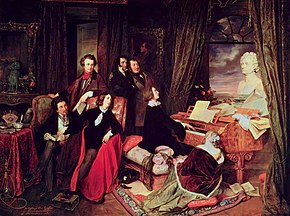
The music of the Romantic era, from roughly the first decade of the 19th century to the early 20th century, was characterized by increased attention to an extended melodic line, likewise as expressive and emotional elements, paralleling romanticism in other art forms. Musical forms began to intermission from the Classical era forms (even equally those were being codification), with gratis-grade pieces like nocturnes, fantasias, and preludes being written where accustomed ideas most the exposition and development of themes were ignored or minimized.[78] The music became more chromatic, dissonant, and tonally colorful, with tensions (with respect to accustomed norms of the older forms) nigh key signatures increasing.[79] The fine art song (or Lied) came to maturity in this era, as did the epic scales of k opera, ultimately transcended by Richard Wagner's Ring cycle.[lxxx]
In the 19th century, musical institutions emerged from the control of wealthy patrons, as composers and musicians could construct lives independent of the nobility. Increasing interest in music by the growing middle classes throughout western Europe spurred the creation of organizations for the instruction, performance, and preservation of music. The pianoforte, which accomplished its mod construction in this era (in part due to industrial advances in metallurgy) became widely pop with the heart class, whose demands for the instrument spurred many pianoforte builders. Many symphony orchestras engagement their founding to this era.[79] Some musicians and composers were the stars of the twenty-four hours; some, similar Franz Liszt and Niccolò Paganini, fulfilled both roles.[81]
European cultural ideas and institutions began to follow colonial expansion into other parts of the globe. There was also a rise, especially toward the stop of the era, of nationalism in music (echoing, in some cases, political sentiments of the time), as composers such every bit Edvard Grieg, Nikolai Rimsky-Korsakov, and Antonín Dvořák echoed traditional music of their homelands in their compositions.[82]
In the Romantic era, the modern piano, with a more than powerful, sustained tone and a wider range took over from the more delicate-sounding fortepiano. In the orchestra, the existing Classical instruments and sections were retained (string section, woodwinds, contumely, and percussion), but these sections were typically expanded to make a fuller, bigger sound. For instance, while a Bizarre orchestra may have had two double bass players, a Romantic orchestra could have equally many as ten. "As music grew more than expressive, the standard orchestral palette just wasn't rich enough for many Romantic composers."[83]
The families of instruments used, specially in orchestras, grew larger; a process that climaxed in the early 20th century with very big orchestras used by late romantic and modernist composers. A wider array of percussion instruments began to announced. Brass instruments took on larger roles, every bit the introduction of rotary valves made information technology possible for them to play a wider range of notes. The size of the orchestra (typically around 40 in the Classical era) grew to exist over 100.[79] Gustav Mahler'due south 1906 Symphony No. 8, for instance, has been performed with over 150 instrumentalists and choirs of over 400.[84] New woodwind instruments were added, such every bit the contrabassoon, bass clarinet and piccolo and new percussion instruments were added, including xylophones, snare drums, celestas (a bell-like keyboard instrument), bells, and triangles,[83] large orchestral harps, and even wind machines for sound effects. Saxophones appear in some scores from the late 19th century onwards, usually featured as a solo musical instrument rather than equally in integral part of the orchestra.
The Wagner tuba, a modified member of the horn family unit, appears in Richard Wagner's cycle Der Ring des Nibelungen. It too has a prominent role in Anton Bruckner's Symphony No. 7 in East Major and is also used in several late romantic and modernist works by Richard Strauss, Béla Bartók, and others[85] Cornets appear regularly in 19th century scores, aslope trumpets which were regarded as less active, at least until the end of the century.
Prominent composers of this era include Pyotr Ilyich Tchaikovsky, Frédéric Chopin, Hector Berlioz, Franz Schubert, Robert Schumann, Felix Mendelssohn, Franz Liszt, Giuseppe Verdi, Richard Wagner, Johannes Brahms, Edvard Grieg, and Johann Strauss 2. Gustav Mahler and Richard Strauss are normally regarded equally transitional composers whose music combines both late romantic and early modernist elements.
20th and 21st centuries [edit]
Modernist [edit]

Encompassing a wide multifariousness of mail service-Romantic styles, modernist classical music includes late romantic, impressionist, expressionist, and neoclassical styles of composition. Modernism marked an era when many composers rejected certain values of the common practice menses, such as traditional tonality, tune, instrumentation, and structure. Some music historians regard musical modernism equally an era extending from about 1890 to 1930.[86] [87] Others consider that modernism ended with one or the other of the two world wars.[88] Still other authorities claim that modernism is not associated with whatsoever historical era, but rather is "an mental attitude of the composer; a living construct that can evolve with the times".[89] Despite its refuse in the last third of the 20th century, at that place remained at the finish of the century an agile core of composers who connected to advance the ideas and forms of modernism, such as Pierre Boulez, Pauline Oliveros, Toru Takemitsu, George Benjamin, Jacob Druckman, Brian Ferneyhough, George Perle, Wolfgang Rihm, Richard Wernick, Richard Wilson, and Ralph Shapey.[90]
2 musical movements that were dominant during this fourth dimension were the impressionist beginning effectually 1890 and the expressionist that started around 1908. It was a period of various reactions in challenging and reinterpreting older categories of music, innovations that pb to new ways of organizing and approaching harmonic, melodic, sonic, and rhythmic aspects of music, and changes in artful worldviews in close relation to the larger identifiable period of modernism in the arts of the fourth dimension. The operative word most associated with information technology is "innovation".[91] Its leading feature is a "linguistic plurality", which is to say that no unmarried music genre ever causeless a ascendant position.[92]
The orchestra connected to grow in size during the early years modernist era, peaking in the first ii decades of the 20th century. Saxophones that appeared only rarely during the 19th century became more than commonly used as supplementary instruments, but never became core members of the orchestra. While appearing only equally featured solo instruments in some works, for example Maurice Ravel's orchestration of Pocket-sized Mussorgsky's Pictures at an Exhibition and Sergei Rachmaninoff'southward Symphonic Dances, the saxophone is included in other works such as Sergei Prokofiev's Romeo and Juliet Suites i and 2 and many other works as a member of the orchestral ensemble. In some compositions such as Ravel'southward Boléro, 2 or more saxophones of different sizes are used to create an entire section similar the other sections of the orchestra. The euphonium is featured in a few late Romantic and 20th century works, commonly playing parts marked "tenor tuba", including Gustav Holst's The Planets, and Richard Strauss'south Ein Heldenleben.
Prominent composers of the early 20th century include Igor Stravinsky, Claude Debussy, Sergei Rachmaninoff, Sergei Prokofiev, Arnold Schoenberg, Nikos Skalkottas, Heitor Villa-Lobos, Anton Webern, Alban Berg, Cécile Chaminade, Paul Hindemith, Aram Khachaturian, George Gershwin, Amy Embankment, Béla Bartók, and Dmitri Shostakovich, forth with the same Mahler and Strauss as transitional figures who carried over from the 19th century.
Post-modern/contemporary [edit]
Postmodern music is a menses of music that began as early as 1930 according to some authorities.[86] [87] Information technology shares characteristics with postmodernist art – that is, art that comes after and reacts against modernism.
Another authorities accept more than or less equated postmodern music with the "contemporary music" composed well after 1930, from the late 20th century through to the early on 21st century.[93] [94] Some of the diverse movements of the postmodern/contemporary era include the neoromantic, neomedieval, minimalist, and mail minimalist.
Gimmicky classical music at the showtime of the 21st century was often considered to include all mail-1945 musical forms.[95] A generation after, this term now properly refers to the music of today written by composers who are nonetheless live; music that came into prominence in the mid-1970s. It includes dissimilar variations of modernist, postmodern, neoromantic, and pluralist music.[90]
Performance [edit]

Performers who accept studied classical music extensively are said to be "classically trained". This training may come from private lessons from instrument or voice teachers or from completion of a formal programme offered by a Conservatory, college or university, such as a Bachelor of Music or Primary of Music degree (which includes individual lessons from professors). In classical music, "...extensive formal music instruction and training, often to postgraduate [Chief's degree] level" is required.[96]
Performance of classical music repertoire requires a proficiency in sight-reading and ensemble playing, harmonic principles, strong ear training (to correct and suit pitches by ear), noesis of functioning exercise (due east.chiliad., Baroque ornamentation), and a familiarity with the manner/musical idiom expected for a given composer or musical piece of work (e.g., a Brahms symphony or a Mozart concerto).[ citation needed ]
The key characteristic of European classical music that distinguishes it from pop music, folk music, and some other classical music traditions such as Indian classical music, is that the repertoire tends to be written down in musical notation, creating a musical role or score.[97] This score typically determines details of rhythm, pitch, and, where two or more musicians (whether singers or instrumentalists) are involved, how the various parts are coordinated. The written quality of the music has enabled a loftier level of complexity inside them: fugues, for instance, achieve a remarkable marriage of boldly distinctive melodic lines weaving in counterpoint all the same creating a coherent harmonic logic. The utilise of written notation besides preserves a tape of the works and enables Classical musicians to perform music from many centuries ago.
Although Classical music in the 2000s has lost near of its tradition for musical improvisation, from the Baroque era to the Romantic era, there are examples of performers who could improvise in the style of their era. In the Baroque era, organ performers would improvise preludes, keyboard performers playing harpsichord would improvise chords from the figured bass symbols beneath the bass notes of the basso continuo part and both vocal and instrumental performers would improvise musical ornaments.[98] Johann Sebastian Bach was especially noted for his circuitous improvisations.[99] During the Classical era, the composer-performer Wolfgang Amadeus Mozart was noted for his ability to improvise melodies in different styles.[100] During the Classical era, some virtuoso soloists would improvise the cadenza sections of a concerto. During the Romantic era, Ludwig van Beethoven would improvise at the piano.[101]
Women in classical music [edit]
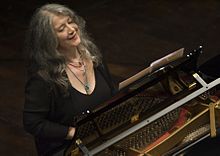
About all of the composers who are described in music textbooks on classical music and whose works are widely performed equally part of the standard concert repertoire are male composers, even though there has been a large number of women composers throughout the classical music period. Musicologist Marcia Citron has asked "[w]hy is music composed by women so marginal to the standard 'classical' repertoire?"[102] Citron "examines the practices and attitudes that have led to the exclusion of women composers from the received 'canon' of performed musical works". She argues that in the 1800s, women composers typically wrote art songs for performance in small recitals rather than symphonies intended for performance with an orchestra in a big hall, with the latter works being seen equally the most important genre for composers; since women composers did not write many symphonies, they were accounted not to exist notable as composers.[102] In the "...Concise Oxford History of Music, Clara Due south[c]humann is ane of the but [sic] female composers mentioned."[103] Abbey Philips states that "[d]uring the 20th century the women who were composing/playing gained far less attention than their male person counterparts."[103]
Historically, major professional orchestras have been by and large or entirely composed of musicians who are men. Some of the primeval cases of women beingness hired in professional orchestras was in the position of harpist. The Vienna Philharmonic, for example, did non accept women to permanent membership until 1997, far later than the other orchestras ranked among the earth's top five by Gramophone in 2008.[104] The last major orchestra to engage a adult female to a permanent position was the Berlin Philharmonic.[105] As tardily as February 1996, the Vienna Combo's principal flute, Dieter Flury, told Westdeutscher Rundfunk that accepting women would be "gambling with the emotional unity ( emotionelle Geschlossenheit ) that this organism currently has".[106] In Apr 1996, the orchestra'south press secretary wrote that "compensating for the expected leaves of absenteeism" of maternity leave would be a trouble.[107]
In 1997, the Vienna Philharmonic was "facing protests during a [US] tour" past the National Arrangement for Women and the International Alliance for Women in Music. Finally, "after being held up to increasing ridicule fifty-fifty in socially conservative Austria, members of the orchestra gathered [on 28 February 1997] in an extraordinary meeting on the eve of their difference and agreed to admit a woman, Anna Lelkes, as harpist."[108] As of 2013, the orchestra has six female members; i of them, violinist Albena Danailova became ane of the orchestra's concertmasters in 2008, the start woman to concur that position.[109] In 2012, women however made up merely 6% of the orchestra'due south membership. VPO president Clemens Hellsberg said the VPO now uses completely screened bullheaded auditions.
In 2013, an article in Mother Jones stated that while "[m]whatsoever prestigious orchestras have meaning female membership—women outnumber men in the New York Philharmonic's violin department—and several renowned ensembles, including the National Symphony Orchestra, the Detroit Symphony, and the Minnesota Symphony, are led past women violinists," the double bass, brass, and percussion sections of major orchestras "...are nevertheless predominantly male".[111] A 2014 BBC commodity stated that the "...introduction of 'bullheaded' auditions, where a prospective instrumentalist performs behind a screen so that the judging panel can exercise no gender or racial prejudice, has seen the gender balance of traditionally male-dominated symphony orchestras gradually shift."[112]
Relationship to other music traditions [edit]
Popular music [edit]
Classical music has ofttimes incorporated elements or material from popular music of the composer's time. Examples include occasional music such as Brahms' utilize of pupil drinking songs in his Academic Festival Overture, genres exemplified by Kurt Weill'due south The Threepenny Opera, and the influence of jazz on early on and mid-20th-century composers including Maurice Ravel, exemplified by the movement entitled "Blues" in his sonata for violin and piano.[113] Some postmodern, minimalist and postminimalist classical composers admit a debt to popular music.[114] [ failed verification ]
Numerous examples show influence in the opposite direction, including pop songs based on classical music, the use to which Pachelbel'southward Canon has been put since the 1970s, and the musical crossover miracle, where classical musicians have achieved success in the popular music arena.[115] In heavy metallic, a number of atomic number 82 guitarists (playing electric guitar), including Ritchie Blackmore and Randy Rhoads,[116] modeled their playing styles on Baroque or Classical-era instrumental music.[117]
Folk music [edit]
Composers of classical music have often fabricated utilize of folk music (music created by musicians who are unremarkably non classically trained, often from a purely oral tradition). Some composers, like Dvořák and Smetana,[118] accept used folk themes to impart a nationalist flavor to their work, while others like Bartók have used specific themes lifted whole from their folk-music origins.[119] Khachaturian widely incorporated into his work the folk music of his native Armenia, just also other indigenous groups of the Middle E and Eastern Europe.[120] [121]
Commercialization [edit]
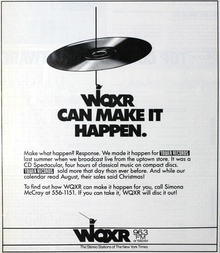
Certain staples of classical music are oft used commercially (either in advertising or in motion-picture show soundtracks). In telly commercials, several passages have go clichéd, specially the opening of Richard Strauss' Also sprach Zarathustra (made famous in the film 2001: A Space Odyssey) and the opening department "O Fortuna" of Carl Orff'south Carmina Burana; other examples include the "Dies irae" from the Verdi Requiem, Edvard Grieg's "In the Hall of the Mount King" from Peer Gynt, the opening confined of Beethoven's Symphony No. 5, Wagner'southward "Ride of the Valkyries" from Die Walküre, Rimsky-Korsakov's "Flying of the Bumblebee", and excerpts of Aaron Copland's Rodeo.[ citation needed ] Several works from the Golden Age of Animation matched the action to classical music. Notable examples are Walt Disney'southward Fantasia, Tom and Jerry's Johann Mouse, and Warner Bros.' Rabbit of Seville and What'southward Opera, Medico?
Similarly, movies and television set often revert to standard, clichéd excerpts of classical music to convey refinement or opulence: some of the most-often heard pieces in this category include Bach´s Cello Suite No. i, Mozart's Eine kleine Nachtmusik, Vivaldi's 4 Seasons, Mussorgsky's Dark on Bald Mountain (as orchestrated by Rimsky-Korsakov), and Rossini'southward "William Tell Overture". Shawn Vancour argues that the commercialization of classical music in the early 20th century may have harmed the music industry through inadequate representation.[122]
Education [edit]
During the 1990s, several inquiry papers and popular books wrote on what came to exist called the "Mozart event": an observed temporary, small height of scores on sure tests as a result of listening to Mozart'due south works. The approach has been popularized in a book by Don Campbell, and is based on an experiment published in Nature suggesting that listening to Mozart temporarily boosted students' IQ past 8 to 9 points.[123] This popularized version of the theory was expressed succinctly by the New York Times music columnist Alex Ross: "researchers... have determined that listening to Mozart actually makes you smarter."[124] Promoters marketed CDs claimed to induce the effect. Florida passed a police force requiring toddlers in state-run schools to listen to classical music every day, and in 1998 the governor of Georgia budgeted $105,000 per twelvemonth to provide every child born in Georgia with a record or CD of classical music. One of the co-authors of the original studies of the Mozart effect commented "I don't think it can hurt. I'one thousand all for exposing children to wonderful cultural experiences. Just I practice think the coin could be meliorate spent on music education programs."[125]
References [edit]
Notes [edit]
- ^ The Ancient Roman citizenship classes in question were derived from the guidelines gear up forth by the legendary king Servius Tullius in the Servian constitution.[12]
- ^ In 1690, many decades afterwards Cotgrave'southward 1611 definition, Antoine Furetière'south posthumous Dictionnaire universel echoed Aulus Gellius in praising Cicero, Julius Caesar, Sallust, Virgil, and Horace and referring to them as classique.[thirteen]
- ^ Earlier the beginning of the 18th-century, there was a cursory flowering of court music post-obit the Stuart Restoration.[eleven] Composers such equally Matthew Locke and later Henry Purcell found considerable success,[17] specially with the popular courtroom masques.[18]
- ^ John Banister'due south concerts quickly gained popularity, allowing him to subsequently motion his venue to Lincoln'south Inn Fields, and and so Essex Street; at its peak, his ensemble consisted of nearly 50 musicians.[xix]
- ^ For further information on the development of a classical music canon in 18th-century England, run into Weber, William (Autumn 1994). "The Intellectual Origins of Musical Canon in Eighteenth-Century England". Journal of the American Musicological Society. 47 (3): 488–520. doi:ten.2307/3128800. JSTOR 3128800.
- ^ Some critics, from the 19th to 21st centuries, divers the First Viennese School in dissimilar means. Commentators such as Johann Wolfgang von Goethe and after Ludwig Finscher excluded Beethoven from the schoolhouse entirely, while the musicologist Friedrich Blume included all 3 in improver to Franz Schubert.[22] Charles Rosen included Haydn, Mozart and Beethoven, just only their instrumental music.[22]
- ^ The primeval employ of the term "classical music" in English literature given past the Oxford English Dictionary (OED) is in the 1829 diary of English musician Vincent Novello, who said "This is the place I should come up to every Dominicus when I wished to hear classical music correctly and judiciously performed".[27] However, this is predated by at least nine years from the title of the English author John Feltham Danneley's 1820 Introduction to the Simple Principles of Thorough Bass and Classical Music.[28] [29] A search in Google Books gives at least three uses of the term "classical music" in the first half of the 18th-century.[xxx]
- ^ In addition to the title of Taruskin 2005, run into also, the titles of Grout 1973, Hanning 2002 and Stolba 1998, all of which include the term "Western music" only essentially exclude non-classical music in the Western globe. Grout 1973 was outset published in 1960, and it was not until the 5th edition prepared by Claude V. Palisca in 1996 that whatsoever information on jazz and popular music was included.[36]
- ^ The musicologist Ralph P. Locke cites composer Tan Dun equally an example, and notes the title of a 2004 publication, Locating Eastern asia in Western Art Music.[37] See too the championship of Barone, Joshua (23 July 2021). "Asian Composers Reverberate on Careers in Western Classical Music". The New York Times. Archived from the original on 28 December 2021.
- ^ From all available evidence, it appears that no, or few, significant musical developments can exist credited to Ancient Rome, who largely adopted the practices of their Ancient Greek predecessors.[43]
- ^ Musicologist Donald Jay Grout notes that even by the 20th century there were merely fragments and a few more sizable examples of such Greco-Roman music that survive.[forty]
Citations [edit]
- ^ a b c d Owens 2008, § para. i.
- ^ a b Schulenberg 2000, p. 99.
- ^ a b c Schulenberg 2000, p. 100.
- ^ Schulenberg 2000, pp. 100–101.
- ^ a b Schulenberg 2000, pp. 102–104.
- ^ a b Schulenberg 2000, pp. 104–105.
- ^ Schulenberg 2000, p. 110.
- ^ Schulenberg 2000, p. 113.
- ^ Owens 2008, § para. ii.
- ^ Owens 2008, § para. seven.
- ^ a b c d e f thou h Heartz 2001, § para. 1.
- ^ a b Howatson, K. C. (2011). "classic". The Oxford Companion to Classical Literature. Oxford: Oxford University Press. ISBN978-0-nineteen-954854-v. Archived from the original on 7 December 2021. Retrieved 10 December 2021.
- ^ a b Mignot, Claude (2017). "Classic". In Cassin, Barbara (ed.). Lexicon of Untranslatables: A Philosophical Dictionary. Princeton: Princeton University Press. ISBN978-0-19-068116-6. Archived from the original on seven Dec 2021. Retrieved 10 December 2021.
- ^ Cotgrave, Randle (1611). A Dictionarie of the French and English Tongues. London: Adam Islip.
- ^ a b c d eastward f Heartz 2001, § para. ii.
- ^ Pauly 1988, p. iii.
- ^ Taruskin 2005, "Restoration".
- ^ Walkling, Andrew R. (February 1996). "Masque and Politics at the Restoration Court: John Crowne'south "Calisto"". Early Music. 24 (1): 27–62. doi:x.1093/em/24.1.27. JSTOR 3128449.
- ^ a b McVeigh 2001, § para. 1–4.
- ^ Weber 1999, p. 345.
- ^ a b Heartz 2001, "2. Earlier 'classicisms'": § para. 1.
- ^ a b c Heartz 2001, "1. The Viennese 'Classical' idiom": § para. ane.
- ^ Schulenberg 2000, pp. 110–111.
- ^ "classical (adj.)". Online Etymology Dictionary. Archived from the original on 17 Nov 2021. Retrieved 1 December 2021.
- ^ Pauly 1988, p. 6.
- ^ Salaman, Charles Chiliad. (1 April 1879). "Classical Music". The Musical Times and Singing Class Circular. 20 (434): 200–203. doi:10.2307/3355606. JSTOR 3355606. Archived from the original on 17 Feb 2022. Retrieved vii February 2022.
- ^ a b "classical, adj. and due north.: A9". OED Online. Oxford: Oxford University Printing. Archived from the original on 17 February 2022. Retrieved 10 December 2021. (subscription required)
- ^ Squire, W. B. (2004). "Danneley, John Feltham (bap. 1785, d. 1834x6), writer on music". In Bakery, Anne Pimlott (ed.). Oxford Lexicon of National Biography. Revised by Anne Pimlott Baker. Oxford: Oxford University Press. doi:10.1093/ref:odnb/7129. ISBN978-0-19-861412-8. Archived from the original on four June 2018. Retrieved 10 December 2021. (subscription or Great britain public library membership required)
- ^ Danneley, John Feltham (1820). An Introduction to the Elementary Principles of Thorough Bass and Classical Music . Ipswich: R. Deck. OCLC 1047597428.
- ^ "Classical music". Archived from the original on 17 February 2022. Retrieved 2 December 2021.
- ^ Kennedy, Michael (1994). "classical". The Oxford Dictionary of Music (New ed.). Oxford and New York: Oxford University Printing. p. 178. ISBN978-0-19-869162-4.
- ^ Pauly 1988, p. 2.
- ^ Nettl, Bruno (1995). Heartland Excursions: Ethnomusicological Reflections on Schools of Music. Champaign: University of Illinois Press. p. 3. ISBN978-0-252-06468-v.
- ^ a b Locke 2012, pp. 320–322.
- ^ Taruskin 2005, "Introduction: The History of What?".
- ^ Burkholder, J. Peter (2009–2010). "Irresolute the Stories We Tell: Repertoires, Narratives, Materials, Goals, and Strategies in Teaching Music History". College Music Symposium. 49/l: 120. JSTOR 41225238.
- ^ a b Locke 2012, p. 321.
- ^ Pauly 1988, pp. three–4.
- ^ Vladimir J. Konečni (2009). "Fashion and tempo in Western classical music of the common-practice era". Empirical Musicology Review. 4 (1). hdl:1811/36604.
- ^ a b c Grout 1973, p. ii.
- ^ a b Grout 1973, p. xi.
- ^ Yudkin 1989, p. 20.
- ^ Grout 1973, pp. 10–11.
- ^ Yudkin 1989, pp. 27–28.
- ^ Yudkin 1989, pp. 28–29.
- ^ Yudkin 1989, p. 25.
- ^ Fassler 2014, p. 28.
- ^ a b c Reese 1940, p. 4.
- ^ Fassler 2014, p. xx.
- ^ Grout 1973, p. four.
- ^ Grout 1973, pp. 4–5, 11.
- ^ Grout 1973, p. 28.
- ^ Grout 1973, pp. xi, 22.
- ^ Grout 1973, p. 24.
- ^ Grout 1973, p. 5.
- ^ Grout 1973, p. 75.
- ^ Blanchard, Bonnie; Blanchard Acree, Cynthia (2009). Making Music and Having a Nail!: A Guide for All Music Students. Indiana University Press. p. 173. ISBN978-0-253-00335-v. Archived from the original on 17 Feb 2022. Retrieved 9 Nov 2020.
- ^ Guides, Rough (three May 2010). The Crude Guide to Classical Music. Rough Guides UK. ISBN978-ane-84836-677-0. Archived from the original on 17 February 2022. Retrieved 21 June 2018 – via Google Books.
- ^ Hoppin 1978, p. 57.
- ^ Bowles 1954, 119 et passim.
- ^ Sachs, Curt (1940), The History of Musical Instruments, Dover Publications, p. 260, ISBN978-0-486-45265-4
- ^ "rabab (musical musical instrument) – Encyclopædia Britannica". Britannica.com. Archived from the original on 17 December 2013. Retrieved 17 August 2013.
- ^ Encyclopædia Britannica (2009), lira, Encyclopædia Britannica Online, archived from the original on 1 August 2009, retrieved 20 Feb 2009
- ^ Grout 1973, p. 61.
- ^ Grout 1973, pp. 75–76.
- ^ Grout 1973, pp. 175–176.
- ^ Grout 1973, pp. 72–74.
- ^ Grout 1973, p. 222–225.
- ^ a b Kirgiss, Crystal (2004). Classical Music. Blackness Rabbit Books. p. half-dozen. ISBN978-1-58340-674-8.
- ^ Grout 1973, pp. 300–32.
- ^ Grout 1973, pp. 341–355.
- ^ Grout 1973, p. 378.
- ^ "Bizarre orchestral music". BBC. Archived from the original on seven June 2019. Retrieved 6 June 2019.
- ^ "Cantata". Encyclopædia Britannica. Archived from the original on vii May 2021. Retrieved iv November 2017.
- ^ "Oratorio". Encyclopædia Britannica. Archived from the original on three June 2021. Retrieved 4 Nov 2017.
- ^ Grout 1973, p. 463.
- ^ Ward Kingdon, Martha (1 Apr 1947). "Mozart and the clarinet". Music & Letters. XXVIII (2): 126–153. doi:10.1093/ml/XXVIII.2.126. Archived from the original on 24 December 2019. Retrieved 5 November 2017.
- ^ Swafford 1992, p. 200.
- ^ a b c Swafford 1992, p. 201
- ^ Grout 1973, pp. 595–612.
- ^ Grout 1973, p. 543.
- ^ Grout 1973, pp. 634, 641–642.
- ^ a b "Romantic music: a beginner's guide – Music Periods". Classic FM. Archived from the original on 30 November 2015. Retrieved 27 November 2015.
- ^ Pitcher, John (January 2013). "Nashville Symphony". American Record Guide. 76 (1): 8–10.
- ^ "The Wagner Tuba". The Wagner Tuba. Archived from the original on ten Feb 2014. Retrieved 4 June 2014.
- ^ a b Károlyi 1994, p. 135
- ^ a b Meyer 1994, pp. 331–332
- ^ Albright 2004, p. 13.
- ^ McHard 2008, p. 14.
- ^ a b Botstein 2001, §9.
- ^ Metzer 2009, p. 3.
- ^ Morgan 1984, p. 443.
- ^ Sullivan 1995, p. 217.
- ^ Beard & Gloag 2005, p. 142.
- ^ "Contemporary" in Du Noyer 2003, p. 272
- ^ "Task Guide – Classical Musician". Inputyouth.co.uk. Archived from the original on 1 Oct 2015. Retrieved 27 Nov 2015.
- ^ LaFleur, Ezra (28 May 2020). "What is Classical Music? A Family Resemblance". ezralafleur.com. Archived from the original on 11 June 2020. Retrieved 28 May 2020.
- ^ Gabriel Solis, Bruno Nettl. Musical Improvisation: Art, Education, and Society. Academy of Illinois Printing, 2009. p. 150
- ^ "On Baroque Improvisation". Community.middlebury.edu. Archived from the original on 27 Nov 2015. Retrieved 27 November 2015.
- ^ David Grayson. Mozart: Piano Concertos Nos. 20 and 21. Cambridge Academy Press, 1998. p. 95
- ^ Tilman Skowronek. Beethoven the Pianist. Cambridge University Press, 2010. p. 160
- ^ a b Citron, Marcia J. (1993). Gender and the Musical Canon . CUP Archive. ISBN978-0-521-39292-i. .[ page needed ]
- ^ a b Abbey Philips (i September 2011). "The history of women and gender roles in music". Rvanews.com. Archived from the original on one October 2015. Retrieved 27 November 2015.
- ^ "The world'southward greatest orchestras". gramophone.co.uk. 24 October 2012. Archived from the original on 4 December 2019. Retrieved 29 Apr 2013.
- ^ James R. Oestreich, "Berlin in Lights: The Woman Question" Archived 19 November 2007 at the Wayback Machine, Arts Beat, The New York Times, 16 November 2007
- ^ WDR 5, "Musikalische Misogynie", 13 February 1996, transcribed past Regina Himmelbauer Archived 22 December 2019 at the Wayback Machine; translation by William Osborne Archived 18 July 2021 at the Wayback Car
- ^ "The Vienna Philharmonic'southward Letter of Response to the Gen-Mus List". Osborne-conant.org. 25 February 1996. Archived from the original on 22 Oct 2018. Retrieved 5 October 2013.
- ^ Jane Perlez, "Vienna Combo Lets Women Bring together in Harmony" Archived 25 June 2017 at the Wayback Machine, The New York Times, 28 Feb 1997
- ^ "Vienna opera appoints first ever female concertmaster". France 24. 8 May 2008. Archived from the original on 5 May 2009.
- ^ Hannah Levintova. "Hither's Why You Seldom See Women Leading a Symphony". Female parent Jones. Archived from the original on 24 Nov 2015. Retrieved 27 November 2015.
- ^ Burton, Charity (21 October 2014). "Culture – Why aren't in that location more than women conductors?". BBC. Archived from the original on 23 November 2015. Retrieved 27 November 2015.
- ^ Kelly, Barbara L. (2001). "Ravel, Maurice, §3: 1918–37". In Sadie, Stanley; Tyrrell, John (eds.). The New Grove Dictionary of Music and Musicians (2nd ed.). London: Macmillan.
- ^ See, for example, Siôn, Pwyll Ap (2001). "Nyman, Michael". In Sadie, Stanley; Tyrrell, John (eds.). The New Grove Dictionary of Music and Musicians (2nd ed.). London: Macmillan.
- ^ Notable examples are the Hooked on Classics series of recordings made by the Regal Philharmonic Orchestra in the early 1980s and the classical crossover violinists Vanessa Mae and Catya Maré.
- ^ Carew, Francis Wayne (1 January 2018). The Guitar Voice of Randy Rhoads (Master of Arts). Wayne State University. pp. 1–2. Archived from the original on 29 March 2019. Retrieved ii October 2019.
- ^ Walser, Robert (October 1992). "Eruptions: heavy metal appropriations of classical virtuosity". Popular Music. 11 (3): 263–308. doi:10.1017/s0261143000005158. ISSN 0261-1430.
- ^ Yeomans, David (2006). Piano Music of the Czech Romantics: A Performer'due south Guide. Indiana Academy Press. p. two. ISBN978-0-253-21845-2.
- ^ Stevens, Haley; Gillies, Malcolm (1993). The Life and Music of Béla Bartók. Oxford: Clarendon Press. p. 129. ISBN978-0-xix-816349-7.
- ^ Bakst, James (1977). "Khachaturyan". A History of Russian-Soviet Music (Reprint ed.). Westport, Connecticut: Greenwood Press. p. 336. ISBN0837194229.
- ^ Rosenberg, Kenyon C. (1987). "Khachaturian, Aram". A Bones Classical and Operatic Recordings Collection for Libraries. Metuchen, New Bailiwick of jersey: Scarecrow Printing. p. 112. ISBN9780810820418.
- ^ Vancour, Shawn (March 2009). "Popularizing the Classics: Radio's Function in the Music Appreciation Movement 1922–34". Media, Culture and Society. 31 (ii): xix. doi:x.1177/0163443708100319. S2CID 144331723.
- ^ Steele, Kenneth M.; Bella, Simone Dalla; Peretz, Isabelle; Dunlop, Tracey; Dawe, Lloyd A.; Humphrey, G. Keith; Shannon, Roberta A.; Kirby, Johnny 50.; Olmstead, C. G. (1999). "Prelude or requiem for the 'Mozart effect'?" (PDF). Nature. 400 (6747): 827–828. Bibcode:1999Natur.400..827S. doi:x.1038/23611. PMID 10476959. S2CID 4352029. Archived (PDF) from the original on xxx October 2021. Retrieved 17 Feb 2022.
- ^ Ross, Alex. "Classical View; Listening To Prozac... Er, Mozart" Archived 17 February 2022 at the Wayback Machine, The New York Times, 28 Baronial 1994. Retrieved on 16 May 2008.
- ^ Goode, Erica. "Mozart for Baby? Some Say, Possibly Non" Archived 17 February 2022 at the Wayback Machine, The New York Times, 3 August 1999. Retrieved on 16 May 2008.
Sources [edit]
Books
- Albright, Daniel (2004). Modernism and Music: An Album of Sources. Chicago: University of Chicago Press. ISBN0-226-01267-0.
- Beard, David; Gloag, Kenneth (2005). Musicology: The Key Concepts. London: Routledge. ISBN978-0-415-31692-7.
- Du Noyer, Paul, ed. (2003). The Illustrated Encyclopedia of Music: From Rock, Pop, Jazz, Blue, and Hip-Hop to Classical, Folk, World, and More than. London: Flame Tree. ISBN978-ane-904041-70-2.
- Fassler, Margot (2014). Frisch, Walter (ed.). Music in the Medieval West. Western Music in Context: A Norton History (1st ed.). New York: W. West. Norton & Visitor. ISBN978-0-393-92915-7.
- Grout, Donald Jay (1973). A History of Western Music . New York: W. W. Norton & Company. ISBN978-0-393-09416-9.
- Hanning, Barbara Russano (2002) [1998]. Concise History of Western Music (2nd ed.). New York: W. West. Norton & Visitor. ISBN0-393-97775-7.
- Hoppin, Richard (1978). Medieval Music. The Norton Introduction to Music History (1st ed.). New York: W. Westward. Norton & Company. ISBN978-0-393-09090-1.
- Károlyi, Ottó (1994). Modern British Music: The Second British Musical Renaissance – From Elgar to P. Maxwell Davies. Madison: Fairleigh Dickinson University Press. ISBN0-8386-3532-6.
- McHard, James Fifty. (2008). The Time to come of Modern Music: A Philosophical Exploration of Modernist Music in the 20th Century and Beyond (3rd ed.). Livonia: Iconic Press. ISBN978-0-9778195-1-5.
- Metzer, David Joel (2009). Musical Modernism at the Turn of the Twenty-starting time Century. Music in the Twentieth Century 26. Cambridge: Cambridge University Press. ISBN978-0-521-51779-9.
- Meyer, Leonard B. (1994). Music, the Arts, and Ideas: Patterns and Predictions in Twentieth-Century Culture (2nd ed.). Chicago: Academy of Chicago Press. ISBN0-226-52143-5.
- Pauly, Reinhard G. (1988). Music in the Classic Period (1st ed.). Englewood Cliffs: Prentice Hall.
- Reese, Gustave (1940). Music in the Middle Ages: With an Introduction on the Music of Ancient Times. Lanham, Maryland: W. W. Norton & Company. ISBN978-0-393-09750-4.
- Stolba, K Marie (1998). The Development of Western Music: A History (third ed.). New York: McGraw-Loma Companies. ISBN0-697-29379-3.
- Sullivan, Henry W. (1995). The Beatles with Lacan: Rock 'n' Roll as Requiem for the Modern Age. Sociocriticism: Literature, Society and History Serial 4. New York: P. Lang. ISBN0-8204-2183-nine.
- Swafford, January (1992). The Vintage Guide to Classical Music. New York: Vintage Books. ISBN978-0-679-72805-4.
- Taruskin, Richard (2005). Oxford History of Western Music . New York: Oxford University Press. ISBN978-0-19-516979-9.
- Weber, William (1999). "The History of Musical Canon" (PDF). In Melt, Nicholas; Everist, Mark (eds.). Rethinking Music. Oxford: Oxford University Press. pp. 336–355. ISBN978-0-nineteen-879003-7.
- Yudkin, Jeremy (1989). Music in Medieval Europe (1st ed.). Upper Saddle River: Prentice Hall. ISBN978-0-13-608192-0.
Journal and encyclopedia articles
- Botstein, Leon (2001). "Modernism". Grove Music Online. Oxford: Oxford Academy Press. doi:ten.1093/gmo/9781561592630.article.40625. ISBN978-one-56159-263-0. (subscription or UK public library membership required)
- Bowles, Edmund A. (1954). "Haut and Bas: The Grouping of Musical Instruments in the Middle Ages". Musica Disciplina. 8: 115–140. JSTOR 20531877.
- Heartz, Daniel (2001). "Classical". Grove Music Online. Revised past Bruce Alan Brown. Oxford: Oxford University Press. doi:ten.1093/gmo/9781561592630.article.05889. ISBN978-1-56159-263-0. (subscription or UK public library membership required)
- Locke, Ralph P. (2012). "On Exoticism, Western Art Music, and the Words We Utilize". Archiv für Musikwissenschaft. 69 (H. 4): 318–328. JSTOR 23375158.
- McVeigh, Simon (2001). "London(i)". Grove Music Online. Oxford: Oxford University Printing. doi:ten.1093/gmo/9781561592630.commodity.16904. ISBN978-1-56159-263-0. (subscription or United kingdom of great britain and northern ireland public library membership required)
- Morgan, Robert P. (1984). "Secret Languages: The Roots of Musical Modernism". Critical Inquiry. 10 (3): 442–461. doi:10.1086/448257. JSTOR 1343302. S2CID 161937907.
- Schulenberg, David (2000). "History of European Art Music". In Rice, Timothy; Porter, James; Goertzen, Chris (eds.). The Garland Encyclopedia of Earth Music: Europe. Abingdon-on-Thames: Routledge. pp. 99–119. ISBN0-8240-6034-2.
- Owens, Tom C. (2008). "Classical Music". In Stearns, Peter Northward. (ed.). The Oxford Encyclopedia of the Modern Globe . Oxford: Oxford University Press. ISBN978-0-19-517632-2.
Further reading [edit]
- Bryant, Wanda (2000). "Ancient Greek Music". In Rice, Timothy; Porter, James; Goertzen, Chris (eds.). The Garland Encyclopedia of World Music: Europe. Abingdon-on-Thames: Routledge. pp. 77–79. ISBN0-8240-6034-2.
- Hanning, Barbara Russano (2002) [1998]. Concise History of Western Music (2nd ed.). New York: Westward. W. Norton & Company. ISBN0-393-97775-7.
- Johnson, Julian (2002). Who Needs Classical Music?: Cultural Pick and Musical Value. Oxford: Oxford University Press.
- Nettl, Bruno (2000). "The Role of History in Gimmicky European Art-Music Culture". In Rice, Timothy; Porter, James; Goertzen, Chris (eds.). The Garland Encyclopedia of World Music: Europe. Abingdon-on-Thames: Routledge. pp. 89–98. ISBN0-8240-6034-two.
- Nettl, Bruno (2014) [2001]. "Music". Grove Music Online. Oxford: Oxford University Press. doi:10.1093/gmo/9781561592630.article.40476. ISBN978-1-56159-263-0. (subscription or UK public library membership required)
- Randel, Don Michael, ed. (2003). The Harvard Dictionary of Music (4th ed.). Cambridge: Harvard Academy Press. ISBN978-0674011632.
- Scholes, Percy (1988). The New Oxford Companion to Music. Oxford: Oxford Academy Press. ISBN0-19-311316-iii.
- Seebass, Tilman (2000). "Notation and Transmission in European Music History". In Rice, Timothy; Porter, James; Goertzen, Chris (eds.). The Garland Encyclopedia of World Music: Europe. Abingdon-on-Thames: Routledge. pp. 80–88. ISBN0-8240-6034-two.
- Stolba, Thousand Marie (1998). The Development of Western Music: A History (third ed.). New York: McGraw-Hill Companies. ISBN0-697-29379-3.
External links [edit]
- Grove Music Online – online version of The New Grove Dictionary of Music and Musicians.
- MGG Online – online version of Die Musik in Geschichte und Gegenwart
- Historical classical recordings from the British Library Sound Archive
Source: https://en.wikipedia.org/wiki/Classical_music
0 Response to "People Tree Films Baby's First Sounds Discoveries for Little Ears"
Post a Comment